
Unit Objectives
- Understand the history of Japanese immigration to the United States, the laws regarding Japanese Americans rights to citizenship and property, and the racial discrimination against the Japanese that preceded internment during World War II.
- Describe the physical existence in the internment camps and the day-to-day life of internees.
- Use GIS software to analyze demographic changes in the Japanese American population as a result of internment.
- Analyze the demographic characteristics of the interned Japanese American population in relation to stereotypes held at the time.
- Analyze primary and secondary documents and explain how historical perspectives on the internment experience have changed in the years since World War II.
Related National Standards
|
Common Core standards apply
to the activities in this unit.
Identify those that are appropriate to the particular materials you select to use from this set of history related standards compiled as part of the American Social History Project City University of New York. |
||
|
|
|
|
GIS Activities
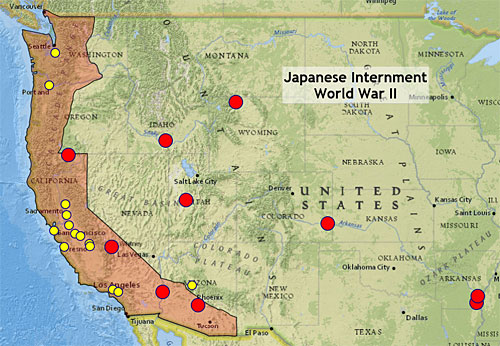
GIS investigations are part of many of the activities in this unit. These investigations make use of ArcGIS Online, an internet software that runs on most browsers. If you do not have an an ArcGIS account and would like to have one you can sign up for a free personal account here.
The Japanese Internment Project files are also available to download for ArcGIS Desktop:
(large file)
The data and shapefiles in the various map layers are from a variety of sources:
California
County Level Data
Shape files from Minnesota Population Center. National Historical Geographic Information System: Pre-release Version 0.1. Minneapolis, MN: University of Minnesota 2004
Census data from Historical Census Browser. Retrieved February, 2007 from the University of Virginia, Geospatial and Statistical Data Center
Records About
Japanese Americans
Relocated During
World War II
Series from Record Group 210: Records of the War Relocation Authority. Retrieved February, 2007 from the National Archives and Records Administration.
Locations of Major World War II Military Bases in California
Warren A. Beck and Ynez D. Haase, Historical Atlas of California, Norman, Oklahoma: University of Oklahoma Press, 1974.
Additional Resources
Densho: The Japanese American Legacy Project is a digital archive of videotaped interviews, photographs, documents, and other materials relating to the Japanese American experience during World War II.
Greg Robinson, By Order of the President: FDR and the Internment of Japanese Americans, Cambridge, MA: Harvard University Press, 2001.
Alice Yang Murray, editor, What Did the Internment of Japanese Americans Mean?, New York: Bedford/St. Matin's, 2000.
Contact
Your comments and suggestion about these materials are more than welcome.
If you have ideas for additional topics that would lend themselves to the approach taken here, please pass them along. I'd enjoy collaborating with you.