The Toxic Residue - Mercury

The impact of gold mining in California over the last one hundred and fifty years is still being felt today. Economically, the price of gold is making both mining and reprocessing of old mine tailings a profitable business again. Environmentally, mining has left a significant toxic residue.

We have mentioned that quicksilver [mercury] is put into sluices to detain the gold. The minute particles of gold form an amalgam with the mercury. The quicksilver, therefore, must be exposed to the gold as much as possible. With this intent, at first only a small amount of washing is done through the sluices, that the spaces between the stones, or blocks, of the pavement, may become partially filled with earth.

Arsenic/Mercury

The quicksilver is then introduced. It is scattered in a light spray all along the sluice. The first charge of quicksilver is between five and six hundred pounds for five thousand feet of sluice. After that the daily charge, applied twice a day, is about one hundred pounds. Much of the quicksilver is regained when separated from the gold....

The quicksilver is then separated from the gold. A quicksilver bath divides the gold from any base metal which may have combined with it. The free mercury may then be obtained by straining through a filter of canvas. After this the amalgam is washed in a bath of water and sulphuric acid, when the mercury is considered pure. The gold and remaining quicksilver is now placed in a retort. The mercury is vaporized by heat, and after passing through a tube, is condensed in water. The pure gold is then removed.1


This description of the use of mercury in the capture of gold presents the first step in a complex web of potentially poisonous environmental events. The activity in the Mercury worksheet will allow you to link together the pieces pictured below in a concept map in order to better understand the effects across time and place of this toxic substance.

Concepts

Let's Go Fishing -

But wait. Even an innocent activity like fishing may be a problem in California's gold country. The incidence of mercury contamination in many of the area's streams, lakes, and reservoirs and the resulting bioaccumulation and biomagnification of mercury in fish should at least give you pause - something to check out.

Buffer

A friend has recommended Indian Creek Reservoir a few miles north of Shingle Springs. Open the El Dorado GIS file and use the bookmark to zoom in on Indian Creek Reservoir. Check to see that these layers are on:

  1. El Dorado County
    1. Major Rivers & Lakes
    2. Mining
      1. El Dorado Mines
      2. Principle Areas of Mine Pollution
      3. El Dorado County Rivers
  2. World Street Map

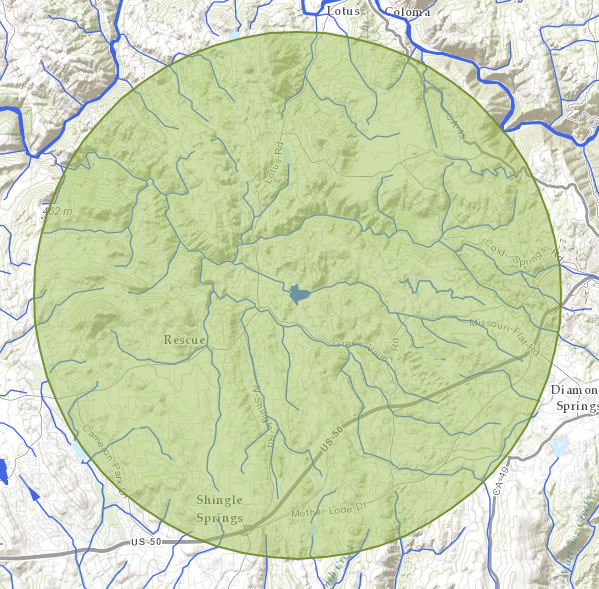
If mercury is a potential problem you'll need to check to see if any of the streams that feed the reservoir drain old mining sites. Follow any streams entering the lake back to their source. Measure the distance from the center of the lake to the most extreme point in its watershed. Use this distance to set up a buffer around the lake like that above.

My World GIS
ArcGIS Explorer

• Select the El Dorado County - Major Rivers & Lakes layer from the table of contents and select Indian Creek Reservoir from the legend on the right.

• Click on the Measure button (Measure ) to select the tool. Click in the center of the lake and then double click at the farthest point in the watershed. The distance is given at the bottom of the screen.

• Click on the Analyze button (Analyze ) and select to Make Buffer Around. Complete the form as indicated below:

Buffer

• Click OK.

* Double click on the new Indian Creek Reservoir layer and set the Colorscheme you want and set the Transparency to 70% so that you can see the map features beneath the buffer.

• Click OK.

• Click on the Measure icon( Measure ) and set the units to Miles.

• Click the measurement tool on the center of the lake and then again at the extreme point in the watershed. The distance is given in the measurement window.

• Click on the Toolbox icon( Toolbox ) and select Analysis Tools > Proximity > Buffer. Enter the input information as pictured below:

Buffer input

• Click OK.

• Right click on the new Buffer layer and select Properties.

• Click on the Display tab and set the layer transparency to 60%.

• Click OK.


There are two layers of mine related information you will want to turn on and check. Mines contains information about approximately 400 mine sites in El Dorado County. The Principle Areas of Mine Pollution layer provides information from the California Department of Conservation about sites that produced significant amounts of ore where pollution may be a major problem. Use the information tool ( Information ) and examine sites from each of these layers.

To Start You Thinking -

1) Not all of the mining sites within the buffer you created are within the watershed of the reservoir. Turn on the Topographic basemap and use the topography of the region to identify the sites from which water will drain into the lake. List these sites by name along with any information about each mine that concerns you.

2) Switch to the World Imagery basemap and zoom in on the various mines you have identified. Describe how land is being used in the vicinity of the old mines in the area.

3) Bottom line - Are you confident enough about the potential level of mercury in Indian Creek Reservoir to eat your catch? Explain.

4) Identify another water body within the watershed of a lake or river in El Dorado County where you would be hesitant to eat your catch. Explain your reasoning.

1Charles B. Turrell, California Notes, San Francisco: E. Bosqui & Co., 1876, as found at The Virtual Museum of the City of San Francisco.

Last modified in January, 2011 by Rick Thomas